| Understanding UV-induced degradation in hybrid back-contact silicon solar cells: the role of AlOₓ passivation【Ning Song】 |
| 发布时间:2026-11-09 | 浏览次数:28 |
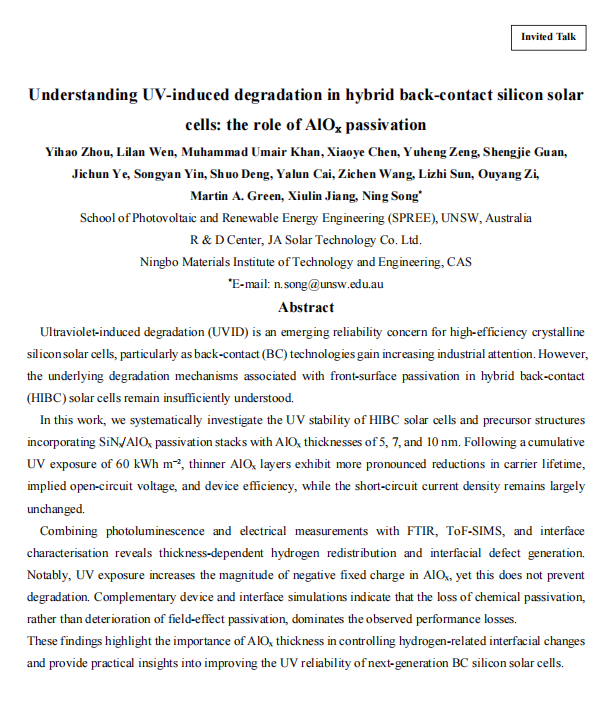
Understanding UV-induced degradation in hybrid back-contact silicon solar cells: the role of AlOₓ passivation Yihao Zhou, Lilan Wen, Muhammad Umair Khan, Xiaoye Chen, Yuheng Zeng, Shengjie Guan, Jichun Ye, Songyan Yin, Shuo Deng, Yalun Cai, Zichen Wang, Lizhi Sun, Ouyang Zi, Martin A. Green, Xiulin Jiang, Ning Song* School of Photovoltaic and Renewable Energy Engineering (SPREE), UNSW, Australia R & D Center, JA Solar Technology Co. Ltd. Ningbo Materials Institute of Technology and Engineering, CAS *E-mail: n.song@unsw.edu.au Abstract Ultraviolet-induced degradation (UVID) is an emerging reliability concern for high-efficiency crystalline silicon solar cells, particularly as back-contact (BC) technologies gain increasing industrial attention. However, the underlying degradation mechanisms associated with front-surface passivation in hybrid back-contact (HIBC) solar cells remain insufficiently understood. In this work, we systematically investigate the UV stability of HIBC solar cells and precursor structures incorporating SiNₓ/AlOₓ passivation stacks with AlOₓ thicknesses of 5, 7, and 10 nm. Following a cumulative UV exposure of 60 kWh m⁻², thinner AlOₓ layers exhibit more pronounced reductions in carrier lifetime, implied open-circuit voltage, and device efficiency, while the short-circuit current density remains largely unchanged. Combining photoluminescence and electrical measurements with FTIR, ToF-SIMS, and interface characterisation reveals thickness-dependent hydrogen redistribution and interfacial defect generation. Notably, UV exposure increases the magnitude of negative fixed charge in AlOₓ, yet this does not prevent degradation. Complementary device and interface simulations indicate that the loss of chemical passivation, rather than deterioration of field-effect passivation, dominates the observed performance losses. These findings highlight the importance of AlOₓ thickness in controlling hydrogen-related interfacial changes and provide practical insights into improving the UV reliability of next-generation BC silicon solar cells.
|