| A hydrogen-mediated device-physics framework for understanding multistage UVID in TOPCon solar cells【刘宗涛】 |
| 发布时间:2026-11-04 | 浏览次数:6 |
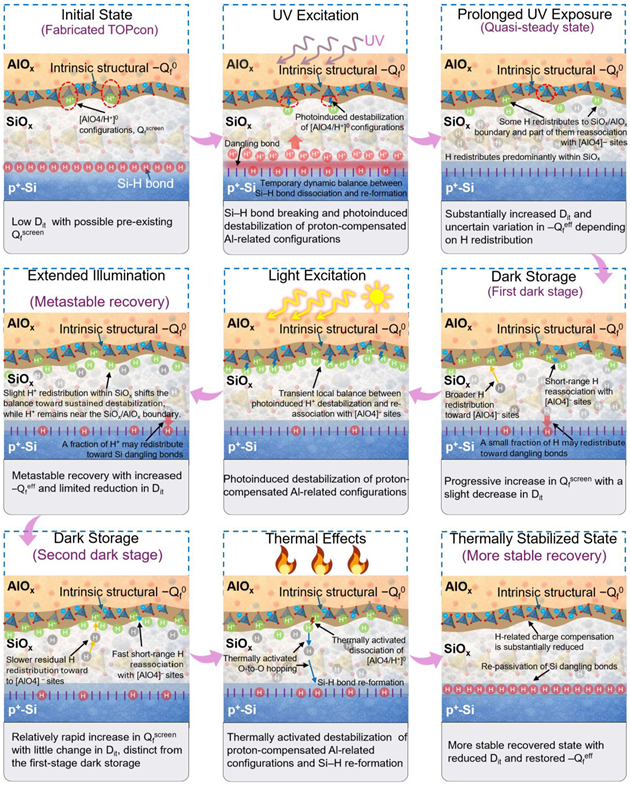
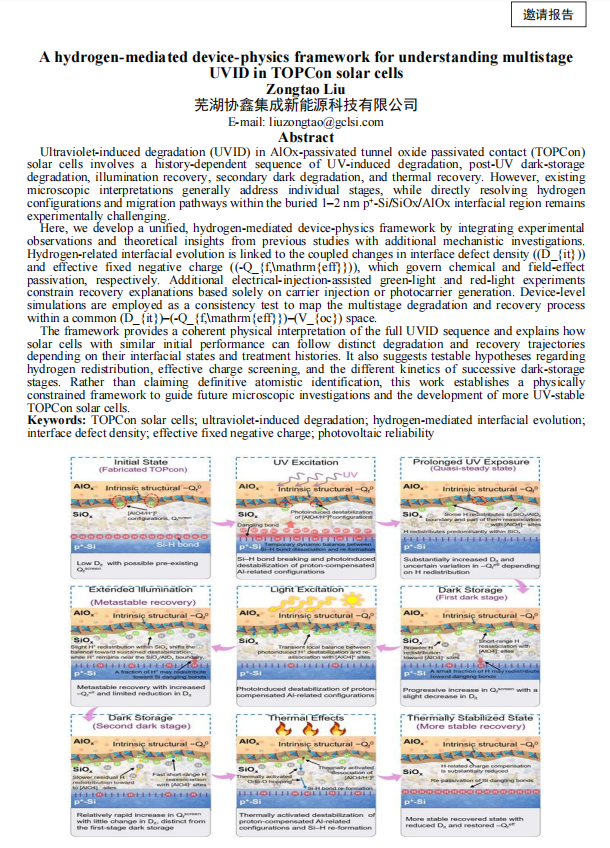
A hydrogen-mediated device-physics framework for understanding multistage UVID in TOPCon solar cellsZongtao Liu 芜湖协鑫集成新能源科技有限公司 E-mail: liuzongtao@gclsi.com Abstract Ultraviolet-induced degradation (UVID) in AlOx-passivated tunnel oxide passivated contact (TOPCon) solar cells involves a history-dependent sequence of UV-induced degradation, post-UV dark-storage degradation, illumination recovery, secondary dark degradation, and thermal recovery. However, existing microscopic interpretations generally address individual stages, while directly resolving hydrogen configurations and migration pathways within the buried 1–2 nm p⁺-Si/SiOx/AlOx interfacial region remains experimentally challenging. Here, we develop a unified, hydrogen-mediated device-physics framework by integrating experimental observations and theoretical insights from previous studies with additional mechanistic investigations. Hydrogen-related interfacial evolution is linked to the coupled changes in interface defect density ((D_{it})) and effective fixed negative charge ((-Q_{f,\mathrm{eff}})), which govern chemical and field-effect passivation, respectively. Additional electrical-injection-assisted green-light and red-light experiments constrain recovery explanations based solely on carrier injection or photocarrier generation. Device-level simulations are employed as a consistency test to map the multistage degradation and recovery process within a common (D_{it})–(-Q_{f,\mathrm{eff}})–(V_{oc}) space. The framework provides a coherent physical interpretation of the full UVID sequence and explains how solar cells with similar initial performance can follow distinct degradation and recovery trajectories depending on their interfacial states and treatment histories. It also suggests testable hypotheses regarding hydrogen redistribution, effective charge screening, and the different kinetics of successive dark-storage stages. Rather than claiming definitive atomistic identification, this work establishes a physically constrained framework to guide future microscopic investigations and the development of more UV-stable TOPCon solar cells. Keywords: TOPCon solar cells; ultraviolet-induced degradation; hydrogen-mediated interfacial evolution; interface defect density; effective fixed negative charge; photovoltaic reliability
|