| Stable luminescent downshifting coatings for efficiency enhancement in commercial silicon photovoltaicsessica 【Jessica Yajie Jiang】 |
| 发布时间:2026-10-13 | 浏览次数:8 |
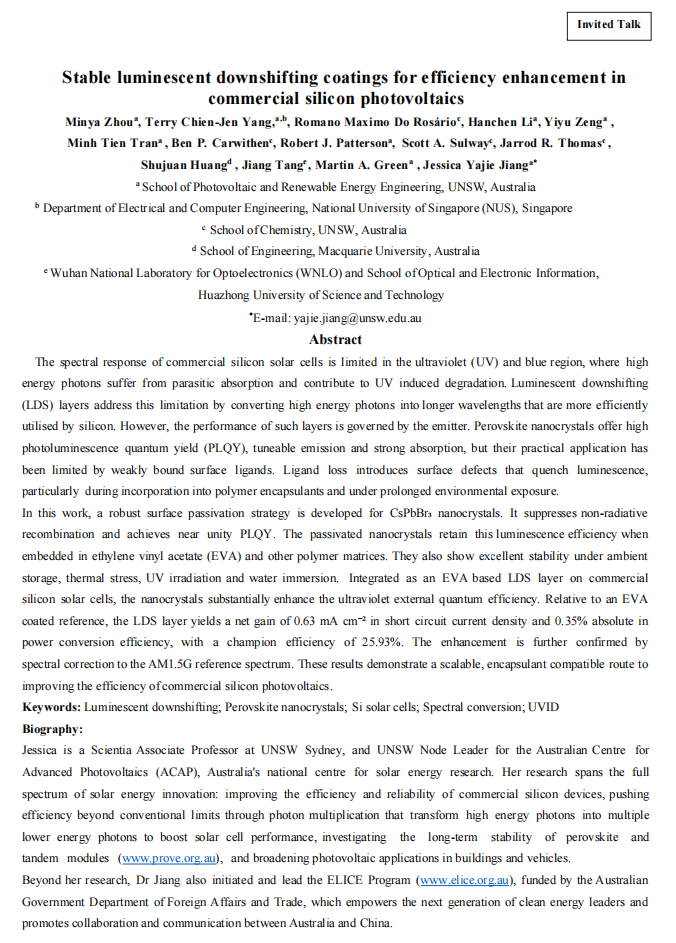
Stable luminescent downshifting coatings for efficiency enhancement in commercial silicon photovoltaics Minya Zhoua, Terry Chien-Jen Yanga,b, Romano Maximo Do Rosárioc, Hanchen Lia, Yiyu Zenga , Minh Tien Trana , Ben P. Carwithenc, Robert J. Pattersona, Scott A. Sulwayc, Jarrod R. Thomasc, Shujuan Huangd , Jiang Tange, Martin A. Greena , Jessica Yajie Jianga* a School of Photovoltaic and Renewable Energy Engineering, UNSW, Australia b Department of Electrical and Computer Engineering, National University of Singapore (NUS), Singapore c School of Chemistry, UNSW, Australia d School of Engineering, Macquarie University, Australia e Wuhan National Laboratory for Optoelectronics (WNLO) and School of Optical and Electronic Information, Huazhong University of Science and Technology *E-mail: yajie.jiang@unsw.edu.au Abstract The spectral response of commercial silicon solar cells is limited in the ultraviolet (UV) and blue region, where high energy photons suffer from parasitic absorption and contribute to UV induced degradation. Luminescent downshifting (LDS) layers address this limitation by converting high energy photons into longer wavelengths that are more efficiently utilised by silicon. However, the performance of such layers is governed by the emitter. Perovskite nanocrystals offer high photoluminescence quantum yield (PLQY), tuneable emission and strong absorption, but their practical application has been limited by weakly bound surface ligands. Ligand loss introduces surface defects that quench luminescence, particularly during incorporation into polymer encapsulants and under prolonged environmental exposure. In this work, a robust surface passivation strategy is developed for CsPbBr₃ nanocrystals. It suppresses non-radiative recombination and achieves near unity PLQY. The passivated nanocrystals retain this luminescence efficiency when embedded in ethylene vinyl acetate (EVA) and other polymer matrices. They also show excellent stability under ambient storage, thermal stress, UV irradiation and water immersion. Integrated as an EVA based LDS layer on commercial silicon solar cells, the nanocrystals substantially enhance the ultraviolet external quantum efficiency. Relative to an EVA coated reference, the LDS layer yields a net gain of 0.63 mA cm⁻² in short circuit current density and 0.35% absolute in power conversion efficiency, with a champion efficiency of 25.93%. The enhancement is further confirmed by spectral correction to the AM1.5G reference spectrum. These results demonstrate a scalable, encapsulant compatible route to improving the efficiency of commercial silicon photovoltaics. Keywords: Luminescent downshifting; Perovskite nanocrystals; Si solar cells; Spectral conversion; UVID Biography: Jessica is a Scientia Associate Professor at UNSW Sydney, and UNSW Node Leader for the Australian Centre for Advanced Photovoltaics (ACAP), Australia's national centre for solar energy research. Her research spans the full spectrum of solar energy innovation: improving the efficiency and reliability of commercial silicon devices, pushing efficiency beyond conventional limits through photon multiplication that transform high energy photons into multiple lower energy photons to boost solar cell performance, investigating the long-term stability of perovskite and tandem modules (www.prove.org.au), and broadening photovoltaic applications in buildings and vehicles. Beyond her research, Dr Jiang also initiated and lead the ELICE Program (www.elice.org.au), funded by the Australian Government Department of Foreign Affairs and Trade, which empowers the next generation of clean energy leaders and promotes collaboration and communication between Australia and China.
|