| Optimal energy alignment and surface adhesion improvement for highly efficient perovskite-silicon tandem solar cells 【Kaining Ding】 |
| 发布时间:2026-10-08 | 浏览次数:10 |
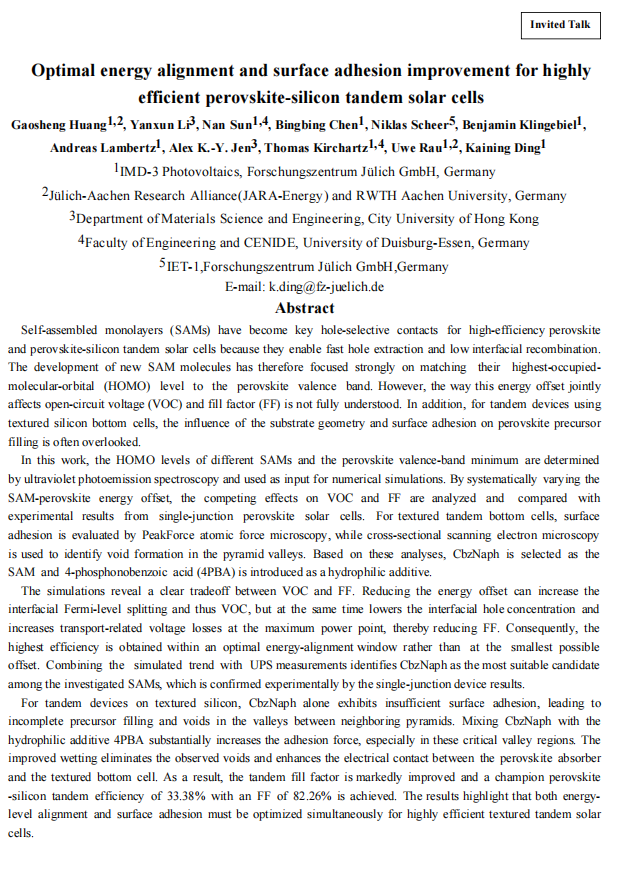
Optimal energy alignment and surface adhesion improvement for highly efficient perovskite-silicon tandem solar cells Gaosheng Huang1,2, Yanxun Li3, Nan Sun1,4, Bingbing Chen1, Niklas Scheer5, Benjamin Klingebiel1, Andreas Lambertz1, Alex K.-Y. Jen3, Thomas Kirchartz1,4, Uwe Rau1,2, Kaining Ding1 1IMD-3 Photovoltaics, Forschungszentrum Jülich GmbH, Germany 2Jülich-Aachen Research Alliance(JARA-Energy) and RWTH Aachen University, Germany 3Department of Materials Science and Engineering, City University of Hong Kong 4Faculty of Engineering and CENIDE, University of Duisburg-Essen, Germany 5IET-1,Forschungszentrum Jülich GmbH,Germany E-mail: k.ding@fz-juelich.de Abstract Self-assembled monolayers (SAMs) have become key hole-selective contacts for high-efficiency perovskite and perovskite-silicon tandem solar cells because they enable fast hole extraction and low interfacial recombination. The development of new SAM molecules has therefore focused strongly on matching their highest-occupied-molecular-orbital (HOMO) level to the perovskite valence band. However, the way this energy offset jointly affects open-circuit voltage (VOC) and fill factor (FF) is not fully understood. In addition, for tandem devices using textured silicon bottom cells, the influence of the substrate geometry and surface adhesion on perovskite precursor filling is often overlooked. In this work, the HOMO levels of different SAMs and the perovskite valence-band minimum are determined by ultraviolet photoemission spectroscopy and used as input for numerical simulations. By systematically varying the SAM-perovskite energy offset, the competing effects on VOC and FF are analyzed and compared with experimental results from single-junction perovskite solar cells. For textured tandem bottom cells, surface adhesion is evaluated by PeakForce atomic force microscopy, while cross-sectional scanning electron microscopy is used to identify void formation in the pyramid valleys. Based on these analyses, CbzNaph is selected as the SAM and 4-phosphonobenzoic acid (4PBA) is introduced as a hydrophilic additive. The simulations reveal a clear tradeoff between VOC and FF. Reducing the energy offset can increase the interfacial Fermi-level splitting and thus VOC, but at the same time lowers the interfacial hole concentration and increases transport-related voltage losses at the maximum power point, thereby reducing FF. Consequently, the highest efficiency is obtained within an optimal energy-alignment window rather than at the smallest possible offset. Combining the simulated trend with UPS measurements identifies CbzNaph as the most suitable candidate among the investigated SAMs, which is confirmed experimentally by the single-junction device results. For tandem devices on textured silicon, CbzNaph alone exhibits insufficient surface adhesion, leading to incomplete precursor filling and voids in the valleys between neighboring pyramids. Mixing CbzNaph with the hydrophilic additive 4PBA substantially increases the adhesion force, especially in these critical valley regions. The improved wetting eliminates the observed voids and enhances the electrical contact between the perovskite absorber and the textured bottom cell. As a result, the tandem fill factor is markedly improved and a champion perovskite-silicon tandem efficiency of 33.38% with an FF of 82.26% is achieved. The results highlight that both energy-level alignment and surface adhesion must be optimized simultaneously for highly efficient textured tandem solar cells.
|