| A unified mechanism for ultraviolet-induced degradation in TOPCon solar cells【Bram Hoex】 |
| 发布时间:2026-10-07 | 浏览次数:16 |
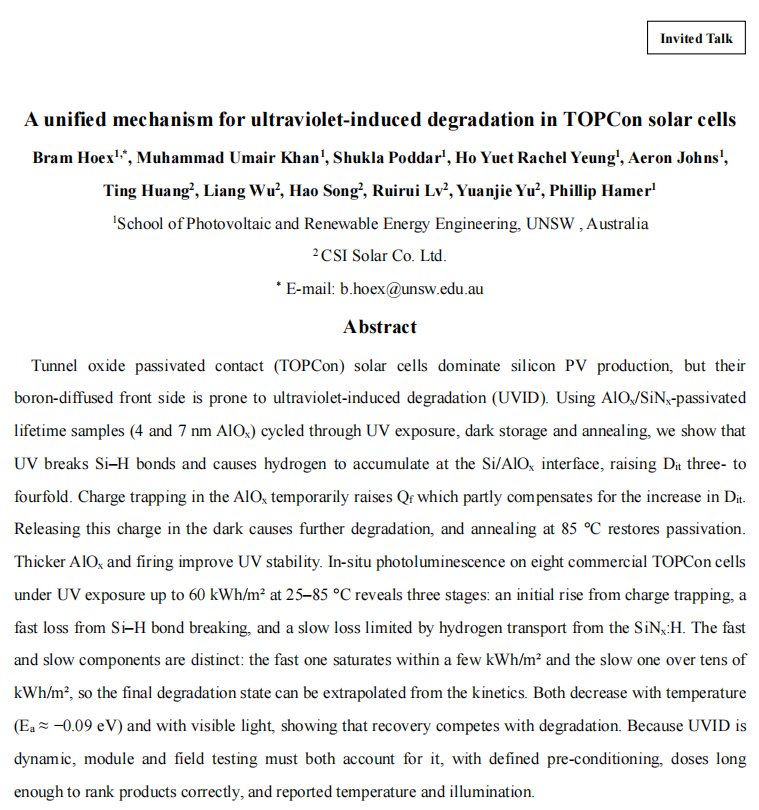
A unified mechanism for ultraviolet-induced degradation in TOPCon solar cells Bram Hoex1,*, Muhammad Umair Khan1, Shukla Poddar1, Ho Yuet Rachel Yeung1, Aeron Johns1, Ting Huang2, Liang Wu2, Hao Song2, Ruirui Lv2, Yuanjie Yu2, Phillip Hamer1 1School of Photovoltaic and Renewable Energy Engineering, UNSW , Australia 2 CSI Solar Co. Ltd. * E-mail: b.hoex@unsw.edu.au Abstract Tunnel oxide passivated contact (TOPCon) solar cells dominate silicon PV production, but their boron-diffused front side is prone to ultraviolet-induced degradation (UVID). Using AlOₓ/SiNₓ-passivated lifetime samples (4 and 7 nm AlOₓ) cycled through UV exposure, dark storage and annealing, we show that UV breaks Si–H bonds and causes hydrogen to accumulate at the Si/AlOₓ interface, raising Dit three- to fourfold. Charge trapping in the AlOₓ temporarily raises Qf which partly compensates for the increase in Dit. Releasing this charge in the dark causes further degradation, and annealing at 85 °C restores passivation. Thicker AlOₓ and firing improve UV stability. In-situ photoluminescence on eight commercial TOPCon cells under UV exposure up to 60 kWh/m² at 25–85 °C reveals three stages: an initial rise from charge trapping, a fast loss from Si–H bond breaking, and a slow loss limited by hydrogen transport from the SiNₓ:H. The fast and slow components are distinct: the fast one saturates within a few kWh/m² and the slow one over tens of kWh/m², so the final degradation state can be extrapolated from the kinetics. Both decrease with temperature (Ea ≈ −0.09 eV) and with visible light, showing that recovery competes with degradation. Because UVID is dynamic, module and field testing must both account for it, with defined pre-conditioning, doses long enough to rank products correctly, and reported temperature and illumination. Keywords: TOPCon; UV induced degradation Biography: Bram Hoex is a Professor and Deputy Head at UNSW Sydney's School of Photovoltaic and Renewable Energy Engineering. His research focuses on solar cell efficiency improvement, reliability and performance, financial and performance yield modelling, and the application of artificial intelligence for material discovery. He published over 300 papers and has received multiple international awards, including the 2008 SolarWorld Junior Einstein and 2016 IEEE PVSC Young Professional. In 2018, Renewable Energy World featured him on their global "Solar 40 under 40" list.
|