| Pioneering silver-lean metallisation for sustainable terawatt-scale PV【Brett Hallam】 |
| 发布时间:2026-10-07 | 浏览次数:12 |
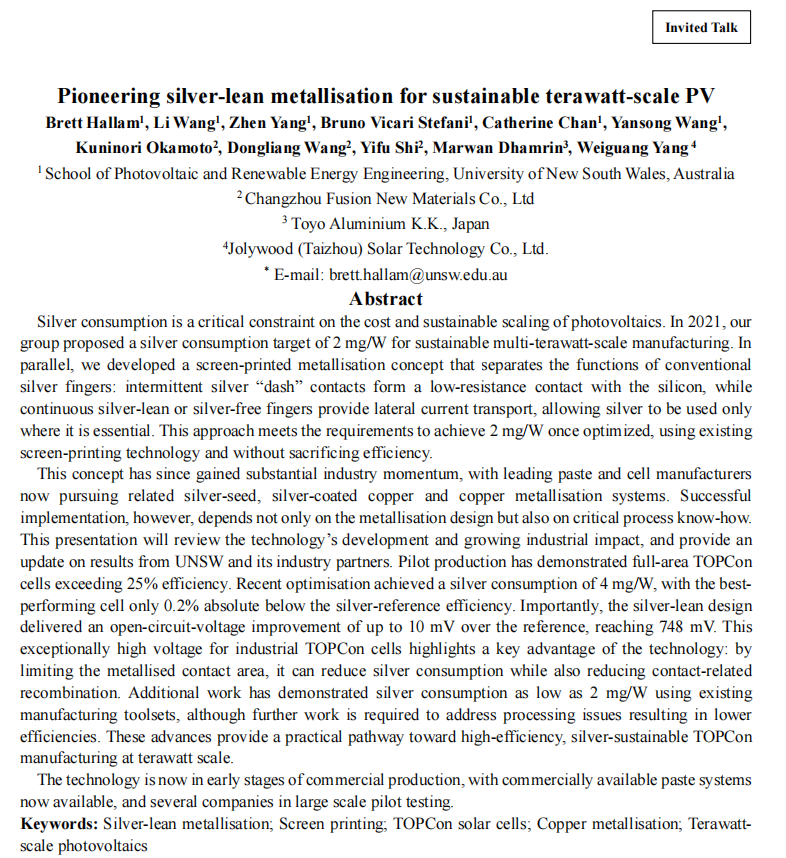
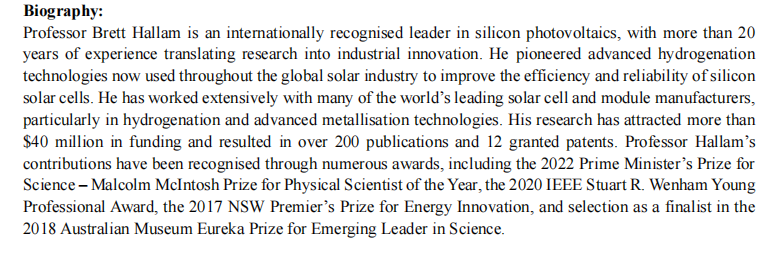
Pioneering silver-lean metallisation for sustainable terawatt-scale PV Brett Hallam1, Li Wang1, Zhen Yang1, Bruno Vicari Stefani1, Catherine Chan1, Yansong Wang1, Kuninori Okamoto2, Dongliang Wang2, Yifu Shi2, Marwan Dhamrin3, Weiguang Yang 4 1 School of Photovoltaic and Renewable Energy Engineering, University of New South Wales, Australia 2 Changzhou Fusion New Materials Co., Ltd 3 Toyo Aluminium K.K., Japan 4Jolywood (Taizhou) Solar Technology Co., Ltd. * E-mail: brett.hallam@unsw.edu.au Abstract Silver consumption is a critical constraint on the cost and sustainable scaling of photovoltaics. In 2021, our group proposed a silver consumption target of 2 mg/W for sustainable multi-terawatt-scale manufacturing. In parallel, we developed a screen-printed metallisation concept that separates the functions of conventional silver fingers: intermittent silver “dash” contacts form a low-resistance contact with the silicon, while continuous silver-lean or silver-free fingers provide lateral current transport, allowing silver to be used only where it is essential. This approach meets the requirements to achieve 2 mg/W once optimized, using existing screen-printing technology and without sacrificing efficiency. This concept has since gained substantial industry momentum, with leading paste and cell manufacturers now pursuing related silver-seed, silver-coated copper and copper metallisation systems. Successful implementation, however, depends not only on the metallisation design but also on critical process know-how. This presentation will review the technology’s development and growing industrial impact, and provide an update on results from UNSW and its industry partners. Pilot production has demonstrated full-area TOPCon cells exceeding 25% efficiency. Recent optimisation achieved a silver consumption of 4 mg/W, with the best-performing cell only 0.2% absolute below the silver-reference efficiency. Importantly, the silver-lean design delivered an open-circuit-voltage improvement of up to 10 mV over the reference, reaching 748 mV. This exceptionally high voltage for industrial TOPCon cells highlights a key advantage of the technology: by limiting the metallised contact area, it can reduce silver consumption while also reducing contact-related recombination. Additional work has demonstrated silver consumption as low as 2 mg/W using existing manufacturing toolsets, although further work is required to address processing issues resulting in lower efficiencies. These advances provide a practical pathway toward high-efficiency, silver-sustainable TOPCon manufacturing at terawatt scale. The technology is now in early stages of commercial production, with commercially available paste systems now available, and several companies in large scale pilot testing. Keywords: Silver-lean metallisation; Screen printing; TOPCon solar cells; Copper metallisation; Terawatt-scale photovoltaics Biography: Professor Brett Hallam is an internationally recognised leader in silicon photovoltaics, with more than 20 years of experience translating research into industrial innovation. He pioneered advanced hydrogenation technologies now used throughout the global solar industry to improve the efficiency and reliability of silicon solar cells. He has worked extensively with many of the world’s leading solar cell and module manufacturers, particularly in hydrogenation and advanced metallisation technologies. His research has attracted more than $40 million in funding and resulted in over 200 publications and 12 granted patents. Professor Hallam’s contributions have been recognised through numerous awards, including the 2022 Prime Minister’s Prize for Science – Malcolm McIntosh Prize for Physical Scientist of the Year, the 2020 IEEE Stuart R. Wenham Young Professional Award, the 2017 NSW Premier’s Prize for Energy Innovation, and selection as a finalist in the 2018 Australian Museum Eureka Prize for Emerging Leader in Science.
|