| Efficiency is not durability: metallisation paste chemistry dictates TOPCon module damp-heat stability【Xinyuan Wu】 |
| 发布时间:2026-10-07 | 浏览次数:13 |
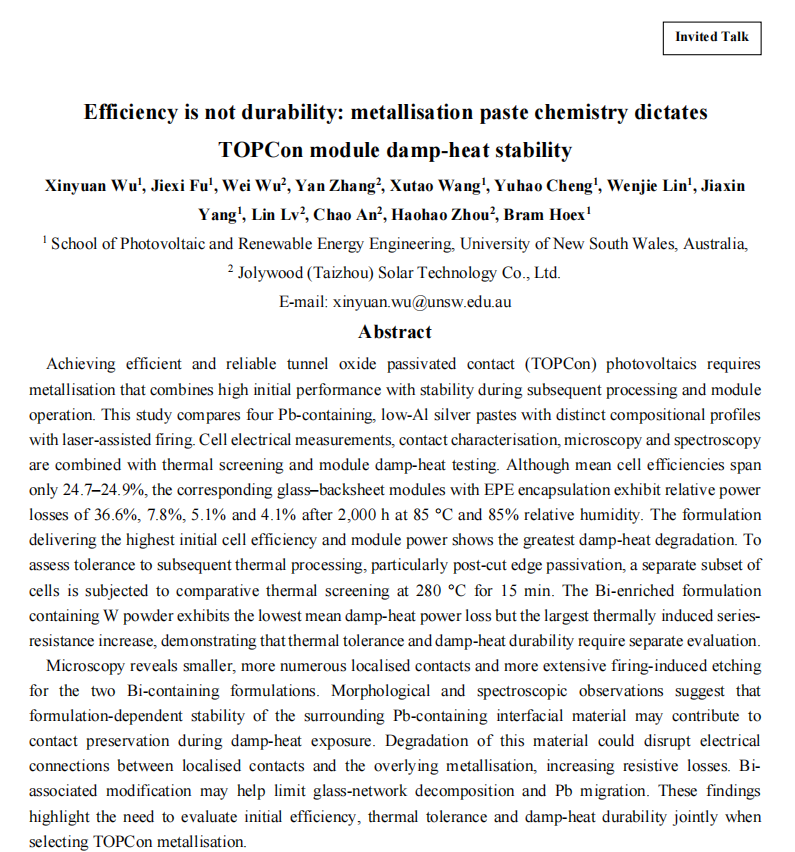
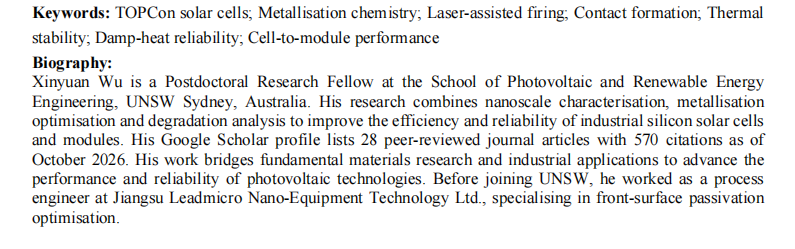
Efficiency is not durability: metallisation paste chemistry dictates TOPCon module damp-heat stability Xinyuan Wu1, Jiexi Fu1, Wei Wu2, Yan Zhang2, Xutao Wang1, Yuhao Cheng1, Wenjie Lin1, Jiaxin Yang1, Lin Lv2, Chao An2, Haohao Zhou2, Bram Hoex1 1 School of Photovoltaic and Renewable Energy Engineering, University of New South Wales, Australia 2 Jolywood (Taizhou) Solar Technology Co., Ltd. E-mail: xinyuan.wu@unsw.edu.au Abstract Achieving efficient and reliable tunnel oxide passivated contact (TOPCon) photovoltaics requires metallisation that combines high initial performance with stability during subsequent processing and module operation. This study compares four Pb-containing, low-Al silver pastes with distinct compositional profiles with laser-assisted firing. Cell electrical measurements, contact characterisation, microscopy and spectroscopy are combined with thermal screening and module damp-heat testing. Although mean cell efficiencies span only 24.7–24.9%, the corresponding glass–backsheet modules with EPE encapsulation exhibit relative power losses of 36.6%, 7.8%, 5.1% and 4.1% after 2,000 h at 85 °C and 85% relative humidity. The formulation delivering the highest initial cell efficiency and module power shows the greatest damp-heat degradation. To assess tolerance to subsequent thermal processing, particularly post-cut edge passivation, a separate subset of cells is subjected to comparative thermal screening at 280 °C for 15 min. The Bi-enriched formulation containing W powder exhibits the lowest mean damp-heat power loss but the largest thermally induced series-resistance increase, demonstrating that thermal tolerance and damp-heat durability require separate evaluation. Microscopy reveals smaller, more numerous localised contacts and more extensive firing-induced etching for the two Bi-containing formulations. Morphological and spectroscopic observations suggest that formulation-dependent stability of the surrounding Pb-containing interfacial material may contribute to contact preservation during damp-heat exposure. Degradation of this material could disrupt electrical connections between localised contacts and the overlying metallisation, increasing resistive losses. Bi-associated modification may help limit glass-network decomposition and Pb migration. These findings highlight the need to evaluate initial efficiency, thermal tolerance and damp-heat durability jointly when selecting TOPCon metallisation. Keywords: TOPCon solar cells; Metallisation chemistry; Laser-assisted firing; Contact formation; Thermal stability; Damp-heat reliability; Cell-to-module performance Biography: Xinyuan Wu is a Postdoctoral Research Fellow at the School of Photovoltaic and Renewable Energy Engineering, UNSW Sydney, Australia. His research combines nanoscale characterisation, metallisation optimisation and degradation analysis to improve the efficiency and reliability of industrial silicon solar cells and modules. His Google Scholar profile lists 28 peer-reviewed journal articles with 570 citations as of October 2026. His work bridges fundamental materials research and industrial applications to advance the performance and reliability of photovoltaic technologies. Before joining UNSW, he worked as a process engineer at Jiangsu Leadmicro Nano-Equipment Technology Ltd., specialising in front-surface passivation optimisation.
|