| Stability issues and recovery strategies for perovskite/silicon tandem solar cells【Junsin Yi】 |
| 发布时间:2026-10-07 | 浏览次数:17 |
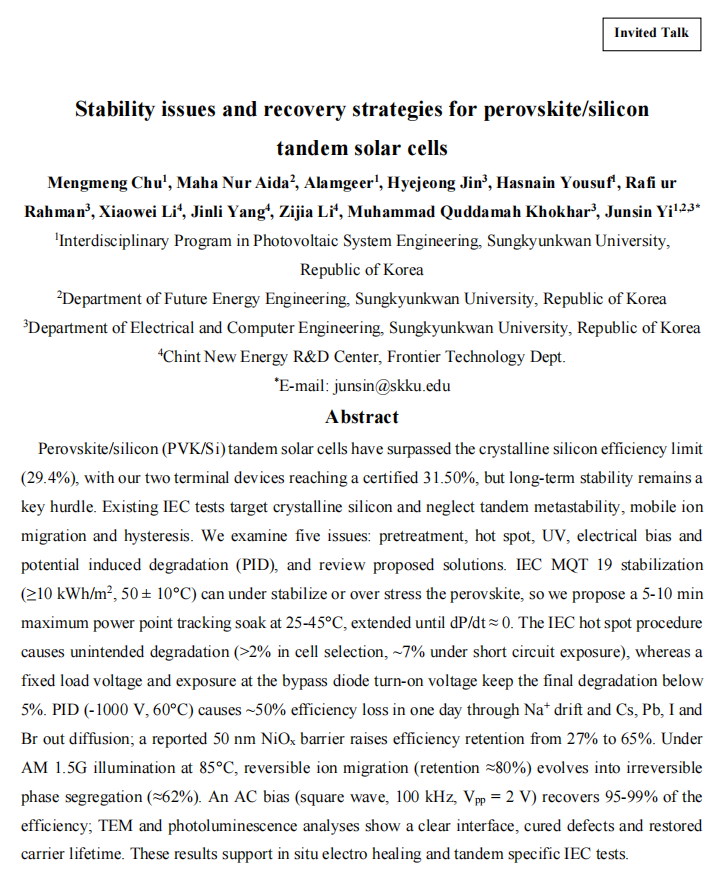
Stability issues and recovery strategies for perovskite/silicon tandem solar cells Mengmeng Chu1, Maha Nur Aida2, Alamgeer1, Hyejeong Jin3, Hasnain Yousuf1, Rafi ur Rahman3, Xiaowei Li4, Jinli Yang4, Zijia Li4, Muhammad Quddamah Khokhar3, Junsin Yi1,2,3* 1Interdisciplinary Program in Photovoltaic System Engineering, Sungkyunkwan University, Republic of Korea 2Department of Future Energy Engineering, Sungkyunkwan University, Republic of Korea 3Department of Electrical and Computer Engineering, Sungkyunkwan University, Republic of Korea 4Chint New Energy R&D Center, Frontier Technology Dept. *E-mail: junsin@skku.edu Abstract Perovskite/silicon (PVK/Si) tandem solar cells have surpassed the crystalline silicon efficiency limit (29.4%), with our two terminal devices reaching a certified 31.50%, but long-term stability remains a key hurdle. Existing IEC tests target crystalline silicon and neglect tandem metastability, mobile ion migration and hysteresis. We examine five issues: pretreatment, hot spot, UV, electrical bias and potential induced degradation (PID), and review proposed solutions. IEC MQT 19 stabilization (≥10 kWh/m2, 50 ± 10°C) can under stabilize or over stress the perovskite, so we propose a 5-10 min maximum power point tracking soak at 25-45°C, extended until dP/dt ≈ 0. The IEC hot spot procedure causes unintended degradation (>2% in cell selection, ~7% under short circuit exposure), whereas a fixed load voltage and exposure at the bypass diode turn-on voltage keep the final degradation below 5%. PID (-1000 V, 60°C) causes ~50% efficiency loss in one day through Na+ drift and Cs, Pb, I and Br out diffusion; a reported 50 nm NiOx barrier raises efficiency retention from 27% to 65%. Under AM 1.5G illumination at 85°C, reversible ion migration (retention ≈80%) evolves into irreversible phase segregation (≈62%). An AC bias (square wave, 100 kHz, Vpp = 2 V) recovers 95-99% of the efficiency; TEM and photoluminescence analyses show a clear interface, cured defects and restored carrier lifetime. These results support in situ electro healing and tandem specific IEC tests.
|